

Every kid who ever begged a parent for money to hit GameStop on release day understands the Yu-Gi-Oh! World Championship series in their bones: it’s the same card game, sold back to you once a year, wearing a slightly fancier hat each time. Konami ran this bit from 2003 to 2006 with the discipline of a Swiss watchmaker and the restraint of absolutely nobody when it came to naming the things. Four games! Four years! Somehow four completely different amounts of the word “World Championship” crammed into each title!

And somewhere in that run, things got weird. By the last entry, Konami had apparently decided Yugi, Kaiba, and the rest of the cast had done enough work, and quietly let you duel the actual monster cards instead, like the whole show got replaced by its own trading cards in some kind of legal dispute. There’s also a tiny RPG town nobody asked for, a cartridge somehow refereeing six languages at once, and just enough real cardboard cards taped inside the box that there’s a real argument the packaging outsold the game.

Grabbing a seat at the table to help me sort genuine dueling nostalgia from pure cardboard-fueled compulsion is William Morgan, host of The Geek Gauntlet Podcast, self-billed as the fastest hour in podcasting, a claim that tracks given how fast he and the crew burn through a week’s worth of comics, movies, anime, and gaming news.

So keep an eye on your Life Points, don’t forget your face-downs, and let’s find out if the World Championship series was Konami’s finest run of Game Boy dueling, or just years of very well-packaged déjà vu.Continue Reading
Back in 1988, CBS gave us Garfield: His 9 Lives, an anthology special where our favorite lasagna enthusiast got to be a caveman, a pampered Egyptian god-cat, and an honest-to-goodness astronaut fending off an interstellar war fleet. Ambitious! Mythic, even! Then in 2006, Lucky Jump Games and The Game Factory looked at that legacy, borrowed the exact same title for a Game Boy Advance platformer, and said: actually, what if his nine lives were a farm, a haunted house, a circus, a sewer, a tree, an alley, an obedience school, and a lab? No pyramids. No space combat. Just Garfield, freshly stuffed from an eating binge, suffering eight increasingly damp nightmares about locations you could reach on foot from his own kitchen.

Climbing out of Garfield’s nightmare to help us survey the damage is Derek B Gayle, who hosts or co-hosts what feels like an ever-multiplying stable of shows including Walloping Websnappers, Gimmicks, Skreeonk!, and, at this point, so many other podcasts that keeping an accurate list may violate several laws of podcast physics. If Garfield hates Mondays, Derek looked at that same feeling and apparently decided the correct response was to start four more podcasts to fill the time.

So raid the fridge, settle in for a night you won’t remember fondly, and let’s find out if Garfield and His Nine Lives earned its spot next to the caveman, the pharaoh, and the astronaut, or if it should’ve stayed exactly the kind of dream you forget the second your alarm goes off.Continue Reading

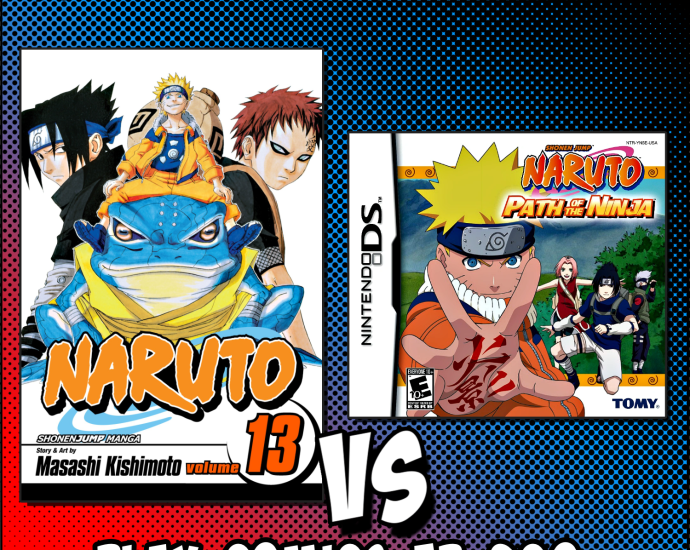
By the mid-2000s, Naruto had pulled off something most manga-to-anime properties never manage: it wasn’t just popular, it was everywhere, spinning off a small army of video games across nearly every system with a screen, like Naruto himself used Shadow Clone Jutsu on the entire games industry and nobody thought to stop him. Somewhere in that flood of Ninja Councils and Clash of Ninjas sits Naruto: Path of the Ninja, the entry that decided the best way to honor Kishimoto’s story wasn’t just punching (though there’s plenty of that too) but actually letting you live through the Land of Waves and the Chūnin Exams one turn-based battle at a time.

Path of the Ninja debuted on the Game Boy Advance in Japan back in 2004, then took a leisurely three years to reach American shelves in 2007, arriving on the Nintendo DS instead, because by the time they got around to localizing it, the GBA already felt like last decade’s news. You pick from six familiar faces, Naruto, Sasuke, Sakura, Shikamaru, Neji, and Rock Lee, pair them into formations for bonus combo attacks, and work through more than 90 jutsu, some of which you cast on the DS touchscreen by frantically scribbling a shape with the stylus, which is either a clever nod to hand seals or just a fun way to give yourself a cramp. The story runs all the way to the Chunin Exam invasion and a face-off with Shukaku, and if you’re wondering whether you can also fight Itachi as a secret bonus boss, the answer is: only if you own the Japanese version. The English release quietly deleted that fight but somehow forgot to scrub his name from the end credits, which is the video game equivalent of hiding a body and leaving the shovel leaning against the wall.

Making another through the Play Comics dojo is Merrilee O’Neil of Fear Coded, last seen on the show trying to keep pace with the Flash. This time she’s trading super speed for shadow clones, hand seals, and a Konoha headband, so at least the running is a little more sustainable.

So form your hand seals, grab your kunai pouch, and let’s find out if Path of the Ninja earned its headband as a worthy trip through early Naruto, or if it should’ve stayed back at the Academy with the rest of the genin.Continue Reading

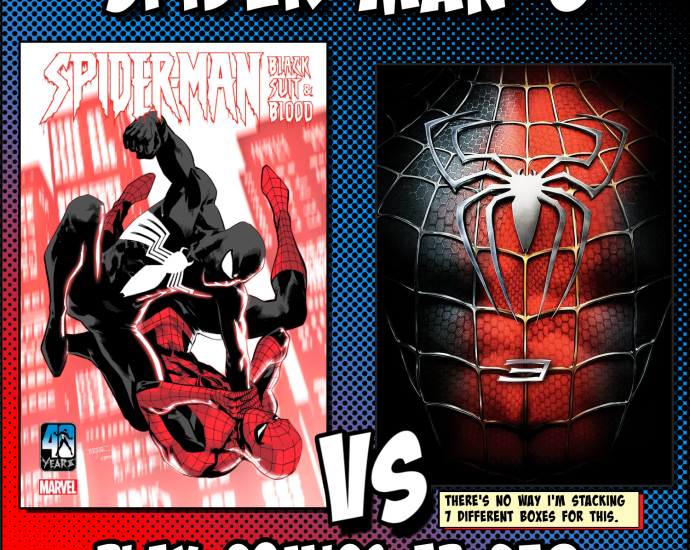
Let’s talk about Spider-Man 3, the movie where Sam Raimi looked at “menacing single antagonist” and said no thank you, I would like three, please, and also I would like Peter Parker to dance down the street like he’s auditioning for a jazz-hands cult. It’s a movie that tried to do everything, mostly succeeded at doing too much, and somehow still made enough money that Activision looked at it and thought: yes, this deserves not one video game, but two, spread across seven different consoles, so that literally nobody in 2007 could escape it. Ambitious! Chaotic! Extremely on brand for the source material!

See, there’s the fancy version, built by Treyarch for PS3, Xbox 360, and PC, where you get a whole open Manhattan to swing around in and the black suit shows up only when the story deems you emotionally ready for it, very mature, very earned. And then there’s the completely different budget cousin, built by Vicarious Visions for PS2, Wii, PSP, GBA, and DS, where you can slap the black suit on whenever you feel like being a jerk, the Wii Remote gets to pretend it’s a web-shooter, and the DS throws the D-pad in the trash entirely so you can beat up Sandman by poking a touchscreen like it owes you money. Same cover art. Same villains. Practically strangers.

Swinging in to help me sort out how many wildly different versions of one questionable movie a single franchise can generate is Harry Steele, co-host of Games on Film, the podcast where he and his brother Rory spend their days grading movies based on video games! Which means Harry has built an entire professional skillset around asking “did Hollywood mess this up,” and today, for one glorious episode, we get to point that same energy directly back at a video game and ask if it managed to mess up the movie right back. Poetic justice! Content symmetry! Whatever you want to call it, it’s happening!

So grab whichever suit you’re feeling today, pick a console, any console, apparently they all made their own decisions, and let’s find out if the Spider-Man 3 games handled three villains and seven platforms with any more finesse than the movie handled three villains and one dance number.Continue Reading

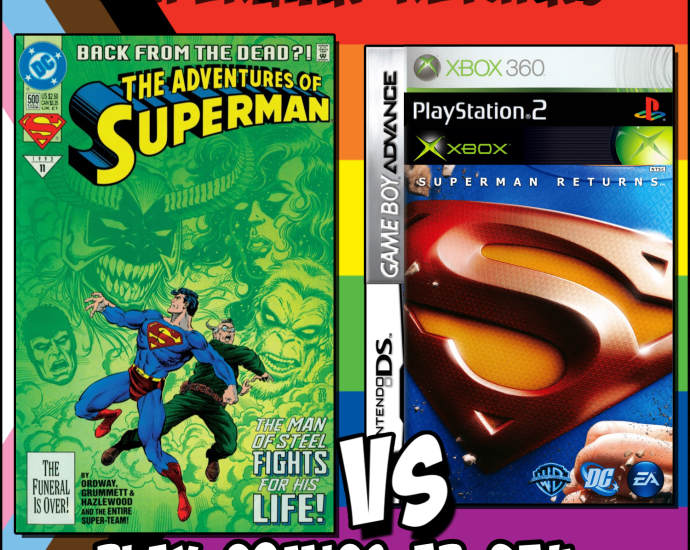
Superman Returns came out in 2006 and asked audiences a very sincere question: what if Superman, but sad? Brandon Routh brooded his way across the big screen, lifting improbable objects and pining for Lois Lane, and somewhere in a boardroom, someone decided this emotionally complex theatrical event needed to be a video game on four different platforms. Five if you count the Game Boy Advance version, which is technically a different game but we’re counting it anyway because we paid good money decided that we just needed to talk about it.

The PS2 and Xbox versions let you fly around Metropolis, absorbing explosions with your face in service of a health bar that belonged to the city rather than Superman himself, which is either a genuinely clever design idea or the most passive-aggressive mechanic in superhero gaming history. The Xbox 360 version turned the whole thing into an open-world showcase for what next-gen hardware could do, which in 2006 meant “look at those buildings.” The DS version was a side-scrolling beat-em-up. The GBA version was something else entirely. Superman Returns contained multitudes, is what we’re saying.

Joining me to dig through the whole sprawling, melancholy, city-defending mess is Adam Williamson, real-life friend, frequent Play Comics guest, and owner of a podcast idea that has been marinating for what I can only describe as a concerning length of time. Adam, I say this with love: at some point you’re going to have to actually make the thing. In the meantime, he’s here, the knowledge is flowing, and we’ve got a Superman game across half a console generation to get through.

So settle in, try not to let the city’s health bar drop to zero, and let’s find out whether Superman Returns deserved better — from Hollywood, from the games industry, and honestly, maybe from all of us.Continue Reading

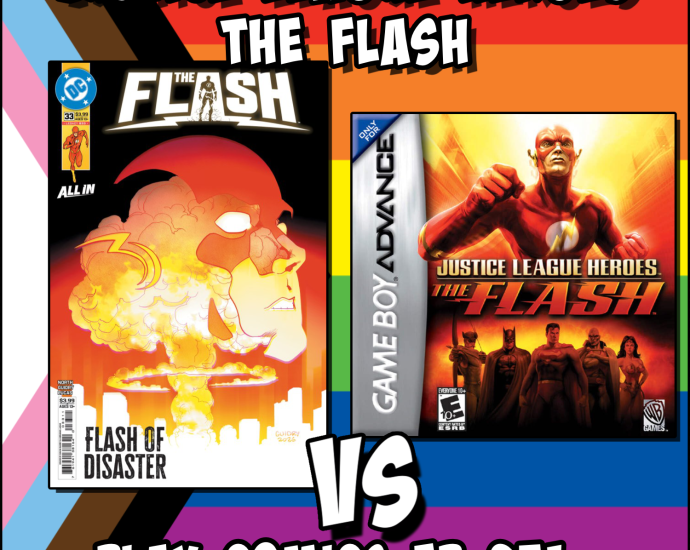
The year was 2006. The Game Boy Advance was winding down, the Justice League animated series had wrapped up, and someone at WayForward Technologies looked at a tiny handheld screen and said, “You know what this needs? The Flash. Running very fast. On a cartridge the size of a business card.” And honestly? Bold decision.

Justice League Heroes: The Flash took the Game Boy Advance, the beloved animated series, and a Justice League comic run and asked the eternal question: how many Rogues can you stuff into a handheld beat-em-up before the whole thing starts wobbling? This episode, we’re finding out. We’re covering the comics, the game, the cartoon connections, and whether Barry Allen or Wally West gets more respect in a world that keeps giving them both the speed force and zero chill.

Joining us to run this whole thing down is Marrilee O’Neil from Fear Coded, who brings exactly the right energy for a conversation about a game that moves fast and expects you to keep up.

So strap in, try not to blink, and let’s do this before the Flash gets impatient and reruns the episode himself.Continue Reading

Some duels are fought with cards. Some are fought with dice. And then some… are fought with the Game Boy Advance’s eternal struggle against decent menu navigation. This week on Play Comics, we’re shuffling up and drawing into Yu-Gi-Oh! Destiny Board Traveler and World Championship Tournament 2004, two games that take everything we love about Yu-Gi-Oh!, monsters, strategy, friendship laser beams, and cram it into a tiny cartridge that smells faintly of childhood and battery corrosion.

Joining Chris for this summoning circle of digital nostalgia is David from Anime Field Guide, who brings the kind of anime expertise that makes you question whether your life points can drop below zero if you cringe too hard at English dub dialogue. Together, they’ll explore why these particular duels feel like being trapped in a friendship-branded fever dream, complete with turn-based confusion and more “draw phase” puns than anyone asked for.

So grab your duel disk, blow into that GBA cartridge like it owes you rent, and prepare to enter a world where forbidden memories and confusing mechanics go hand-in-hand. It’s the heart of the cards… but maybe also a faint cry for a player’s guide.Continue Reading

This week on play comics we ask ourselves what happens if you you can’t decide what you want to make a game about. Should you just give up? Should you really dig into your soul and decide what you’re super passionate about? Should you look and see if there’s any other related media coming out that you can tie this game into? Or should you act like you’re at the end of five different boxes of sugary cereal and justice dump the mall into a single bowl and see what happens?

There’s certainly one thing that I made my mind up about this one, and that’s how Perry Constantine from Superhero Cinephiles and Japan on Film needed to come by and help me make sure that I kept everything straight here. And it’s a good thing too because with more playable character than I want to count spread out across 7 consoles upon release and a few more as back catalogs were taken advantage of it would have been really easy to miss something here.

So was there an actual story for this game? Or was it just a giant excuse to squeeze in as many tidbits as they could so the other kids would think they’re cool? You’ll have to listen to find out!Continue Reading

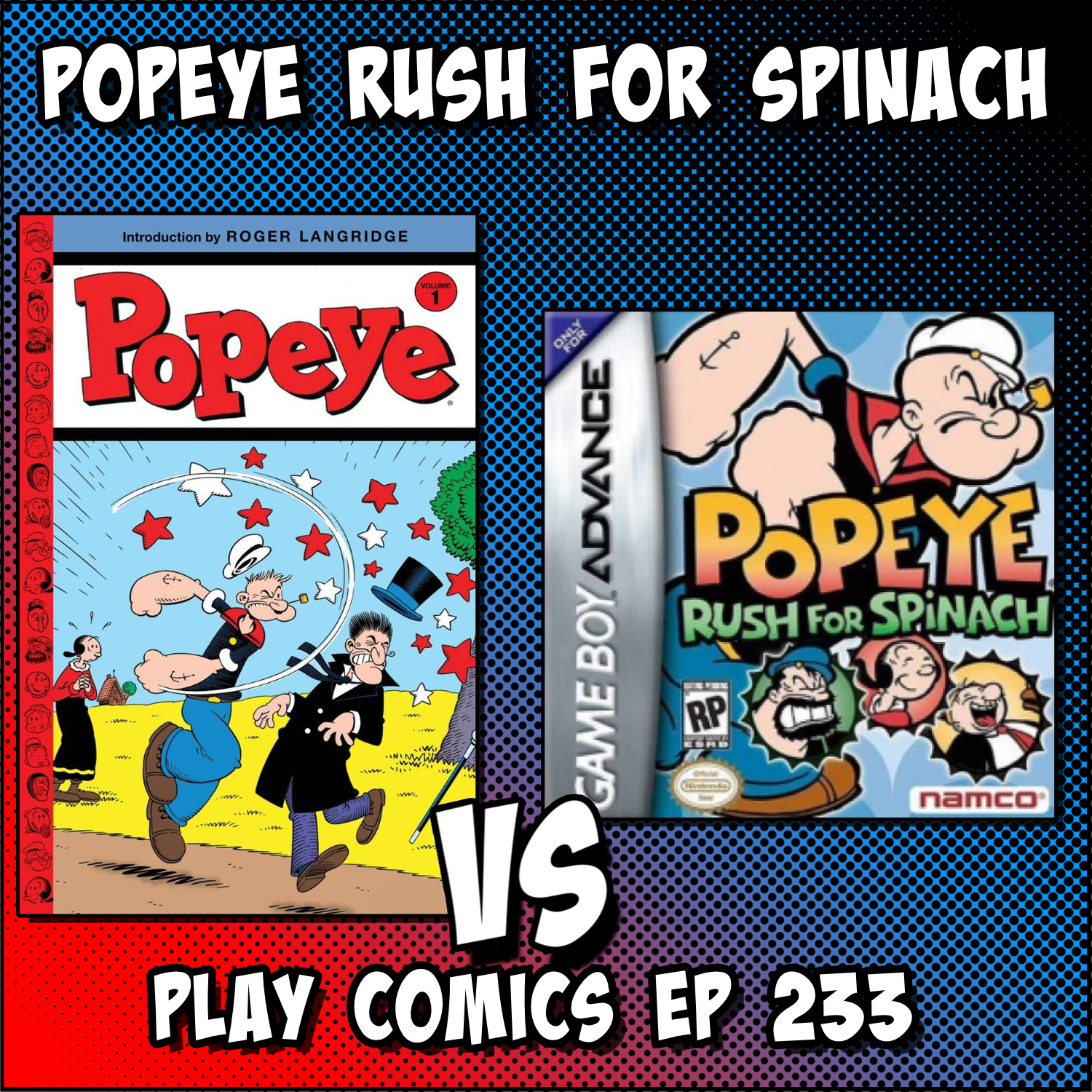
Grab your canned vegetables and your questionable licensed tie-ins, because this week on Play Comics we’re diving headfirst into Popeye: Rush for Spinach on the Game Boy Advance—the game that looked at a classic comic strip about a gruff sailor punching his problems and said, “Actually, what if everyone just… ran a lot instead?” This is a world where the Sea Hag steals the global spinach supply, the solution is apparently time-traveling track meets, and Popeye, Olive Oyl, Bluto, and Wimpy all agree that the best way to settle things is to sprint through history like someone off-screen yelled “last one there buys lunch.”

Helping us untangle this leafy green disaster is the wonderful Ryan Estrada from the comic-making side of the internet, a man who knows exactly what it looks like when characters escape the page and do something absolutely no one asked them to do. Ryan’s here to help figure out how a comic icon who started life in newspaper strips, got famous selling spinach, and spent decades punching sea monsters somehow wound up in a handheld racing game that feels like it was brainstormed during a very strange lunch break.

So power up that tiny GBA screen, flex those forearms, and get ready for an episode that’s equal parts comic history lesson, adaptation autopsy, and incredulous laughter at the phrase “Popeye racing game.”Continue Reading

Listen up, mutation enthusiasts and multi-platform adventurers, because this week on Play Comics we’re strapping on our Kevlar suits and diving straight into the bewildering, beast-infested, cross-console chaos of X-Men: The Official Game! We’re talking about the 2006 game that launched on practically every system known to mankind (GBA, GameCube, Nintendo DS, PS2, Xbox, and Xbox 360. Seriously, did they forget a platform?), which based the story nominally on the third X-Men film from Fox. You know, the one that showed us what happens when Professor Xavier and Magneto finally decided to outsource their beef settlement to a video game developer.

This particular romp through Marvel’s merry mutant universe was brought to you by the folks who looked at a film featuring Wolverine, Nightcrawler, and Iceman and thought, “What if we made this game SLIGHTLY different on each platform?” It’s like they were challenged to see just how elastic the definition of ‘the same game’ could be, and frankly, the results are beautifully inconsistent. The story was co-written by Chris Claremont (yes, THAT Chris Claremont) and Zak Penn, and it featured voice acting from the actual film cast, which means you got Hugh Jackman’s growl in your living room, your handheld, and probably also your neighbors’ living rooms at 2 AM.

Joining us to make sense of this portable and stationary pandemonium is none other than Alex Zalben from Comic Book Club, a weekly live talk show about comics that’s been running since 2006, performed at every major comic convention you can think of, written up in the New York Times more than once, and hosted literally hundreds of guests with more swagger than most podcasts muster in a lifetime. Alex is a writer, editor, and podcaster who knows his way around both four-color storytelling and video game adaptations, making him the perfect guide to help us determine whether this cross-generational, cross-console adventure managed to capture what makes the X-Men actually work, or if it just made us wish we could teleport away from our screens.

So sync up your Danger Room protocols, pick your favorite handheld or home console, and get ready for an episode that’s guaranteed to be more chaotic than a Sentinel factory explosion and infinitely more confusing than trying to figure out why THIS game exists on THAT console!Continue Reading

Welcome, web-slinging console warriors and handheld hop-scotchers! Prepare your cartridges and grab your controllers, because this week on Play Comics we’re diving into the gloriously chaotic streets of New York with Spider-Man: Battle for New York, the 2005/2006 portable powerhouse that took Brian Michael Bendis and Mark Bagley’s Ultimate Spider-Man universe and somehow crammed all of Manhattan’s mayhem into a GBA and DS-sized punch-up bonanza. Because apparently, someone looked at one of the most beloved comic runs of the 2000s and thought, “You know what this needs? A brawler where Spidey spends most of his time frantically hammering the same three buttons while dodging increasingly ridiculous villain attacks.”

Released across Game Boy Advance and Nintendo DS, this wasn’t your typical web-slinging adventure—it was more like someone distilled all of Ultimate Spider-Man’s most explosive moments into a side-scrolling arcade experience where the city itself becomes just as much of an enemy as Green Goblin ever was. With a roster of villains pulled straight from the comics and more “beat stuff up” objectives than you can shake a web at, this game proved that sometimes the best way to honor a beloved comic series is to completely reinvent what it means to be Spider-Man.

This week, we’re absolutely thrilled to welcome the phenomenally knowledgeable Jarrett Tyree from Has To Do With Spider-Man I Think, who brings an encyclopedic understanding of all things Arachnid and animated to help us untangle whether this game managed to capture the kinetic energy of Bendis’s run or if it just left our webbing all tangled in the wrong places. Jarrett’s the kind of Spider-expert who can probably explain exactly why this game makes the choices it does, while also gently reminding us that sometimes video game adaptations are more “inspired by” than “faithful to” the source material.

So strap in your web-shooters, prepare for some serious button-mashing mayhem, and get ready for an episode that explores whether this dual-platform adaptation is a hidden gem of portable gaming or just another case of “well, we had to do SOMETHING with this license.” Let’s see if Battle for New York is worth defending!Continue Reading

Crack open your Millennium Puzzle and prepare to roll some incredibly awkward polygonal dice, because this week on Play Comics we’re delving into one of the most bewildering spin-offs to ever stumble out of the Yu-Gi-Oh universe! We’re talking about Yu-Gi-Oh Dungeon Dice Monsters for the Game Boy Advance—a game so determined to turn Kazuki Takahashi’s trading card phenomenon into a dungeon crawler that it somehow forgot to ask if it should.

Joining us for this delightfully confusing journey through Dungeon Dice Monsters is none other than Marcus Stewart from Game Informer, who’s armed with the kind of gaming knowledge that only comes from actually playing this thing. Whether he’s here to defend it, destroy it, or just figure out what the heck is happening on a 240p screen, we’re thrilled to have his voice in the mix as we attempt to understand why anyone thought “card game meets roguelike dice mechanics” was the logical next step for the King of Games.

So lock your monsters in the vault, prepare your dice for rolling, and get ready for an episode that’s far less about card strategy and far more about watching two people gradually lose their minds over a game that inhabits some kind of strange liminal space between “ambitious experiment” and “fever dream at a game arcade.” The dice have been cast. The dungeon awaits. Our sanity? Well, that’s negotiable.Continue Reading

Welcome, mechanical marvels and atomic adventurers! This week on Play Comics, we’re firing up our reactor cores and diving headfirst into the absolutely electrifying world of Astro Boy Omega Factor for the Game Boy Advance – because apparently someone at Banpresto looked at Osamu Tezuka’s groundbreaking manga and thought, “You know what this 1950s icon needs? A portable fighting game experience where he punches evil robots directly in their non-existent feelings.”

Released in 2003, this 2D brawler took the mighty atom himself and somehow convinced an entire development team that what fans REALLY wanted was the chance to mash buttons while watching our favorite nuclear-powered pint-sized hero exchange haymakers with increasingly ridiculous mechanical adversaries. Sure, the original manga was about philosophical questions of robot rights and what it means to be human, but why dwell on existential dread when you could just… punch things?

Joining us for this high-voltage episode is Hamish Steele from Super Mario Moment – a man who knows a thing or two about platform and fighting game mechanics, though probably with significantly fewer isotope-based superpowers than Astro Boy packs. Together, we’ll explore whether this GBA adaptation captured the essence of Tezuka’s revolutionary creation or if it just left us feeling like we’d been on the receiving end of one of Astro Boy’s arm cannons.

So charge up your atomic energy reserves, practice your most devastating uppercut, and prepare for an episode that’s absolutely radiating with gaming chaos. Will this manga adaptation prove to be a shining beacon of handheld excellence, or will it fizzle out faster than Astro’s battery in a poorly designed dungeon? Time to find out if this portable pugilist belongs in the Hall of Mighty Adaptations or the scrapheap of forgotten GBA obscurities!Continue Reading

Strap on your meat-based wrestling tights and oil up those biceps because Play Comics is about to suplex you straight into the absurdly wonderful world of Kinnikuman! This week we’re tag-teaming not one, but TWO Ultimate Muscle games—The Path of the Superhero for GameCube and Legends vs New Generation for Game Boy Advance. That’s right, we’re going double or nothing like a Choujin who forgot leg day exists and decided to compensate with twice the spandex.

These games, spawned from the legendary Kinnikuman manga and anime, brought us a universe where wrestling isn’t just a sport—it’s the entire basis of intergalactic civilization, which honestly makes about as much sense as any other comic book logic we’ve tackled on this show. Whether you’re commanding Kid Muscle through his heroic quest to not embarrass his legendary father or settling the age-old debate of who would win between old-school wrestlers and the new generation (spoiler: everyone’s finishing move is magnificently ridiculous), we’ve got you covered.

Joining us for this muscle-bound mayhem is none other than SerpyMatt, who hasn’t quite gotten around to launching his own podcast yet—but he’s told me the concept and folks, when it finally drops, you’re going to absolutely love it. Assuming he ever stops procrastinating long enough to record episode one, that is.

So crack your knuckles, practice your most intimidating wrestler growl, and prepare for an episode that’s guaranteed to have more body slams than a physics textbook thrown at a trampoline factory. It’s time to find out if these games captured the magnificent weirdness of their source material or if they just left us feeling like we got hit with the Kinniku Buster of disappointment.Continue Reading

Welcome to another gloriously chaotic episode of Play Comics, where today’s adventure features everyone’s favorite lasagna-loving, Monday-hating tabby cat stumbling through the digital wasteland of Garfield: The Search for Pooky on the Game Boy Advance. Because apparently, losing a teddy bear is serious enough business to warrant an entire platforming odyssey filled with death pits, questionable physics, and mice that probably deserve their own organized crime documentary.

Joining us for this tale of feline desperation and handheld gaming horrors is the phenomenally creative Ryan Estrada—artist, author, and genuine adventurer who has somehow managed to create official comics for everyone from Star Trek to Popeye to (yes, indeed) Garfield himself. When he’s not crafting award-nominated graphic novels like Banned Book Club or wandering through actual adventures that sound like they belong in their own comic series, Ryan brings the perfect blend of insider knowledge and artistic sensibility to help us navigate this particular slice of orange cat chaos.

So grab your favorite plush companion (and maybe hide it somewhere safe), prepare for some seriously questionable level design choices, and settle in for an episode that explores what happens when beloved comic strip characters get translated into the unforgiving world of Game Boy Advance platforming. Will our heroes survive Garfield’s glacially-paced walking speed? Can anyone explain why this cat can leap tall buildings but still can’t find a simple teddy bear? And most importantly, does this game capture the essence of Jim Davis’s creation, or does it just make us want to curl up for a very long nap?Continue Reading

Welcome, card-slinging strategy seekers, to another episode of Play Comics where we shuffle through the deck of comic-to-game adaptations with all the precision of a first-turn Exodia draw gone horribly wrong! Today we’re summoning not one, but TWO Yu-Gi-Oh! adventures that took Yugi’s world from the small screen to handheld hysteria and living room chaos.

First up, we’re diving into Yu-Gi-Oh! Worldwide Edition – Stairway to the Destined Duel for the Game Boy Advance, a portable card battler that somehow managed to cram the entire Battle City tournament into a device smaller than Joey’s brain capacity. Then we’re teleporting to the GameCube dimension with Yu-Gi-Oh! The Falsebound Kingdom, where virtual reality meets real-time strategy in a combination so bizarre it makes Kaiba’s obsession with ancient Egyptian card games seem perfectly reasonable.

Joining us for this interdimensional dueling discussion is the magnificent GothJon from the 2 ACT podcast, whose expertise in anime, cinema, and all things delightfully dark makes him the perfect co-host to help us navigate these shadow realm gaming adventures. Whether we’re discussing the satisfying simplicity of portable dueling or the ambitious madness of strategic monster management, GothJon brings the kind of analytical insight that would make even Pegasus jealous.

So grab your duel disk, power up that millennium puzzle, and prepare for an episode that explores how faithfully these games captured the heart of the cards… or whether they sent us straight to the shadow realm of gaming disappointment. Will these Yu-Gi-Oh! adaptations prove they’ve got what it takes to stand the test of time, or will they end up banished to the extra deck of forgotten licensed gamesmes?

Time to duel… digitally!Continue Reading

Holy cowl-wearing console catastrophe, comic crusaders! This week on Play Comics we’re grappling-hooking our way into the surprisingly deep shadows of 2005’s Batman Begins video game – because apparently someone at Eurocom looked at Christopher Nolan’s gritty reboot and thought, “You know what this needs? A fear meter and the ability to summon actual bats to terrify thugs into submission!”

Released across more platforms than Batman has traumatic childhood memories, this movie tie-in somehow managed to land on PS2, Xbox, GameCube, and Game Boy Advance without completely embarrassing itself in the process. While most movie games crash and burn faster than if I tried to drive the Batmobile, this stealth-action adventure actually tried to do something interesting with its “High Frequency Transponder” gadget and environmental intimidation mechanics that made enemies drop their weapons in sheer terror.

Joining us for this digital descent into Gotham’s criminal underworld is the incredibly talented Wells Thompson, creative mastermind behind indie comic sensations and the brilliant mind that helped bring us The Scorpion and the Queen (among a bunch of other Kickstarter projects) and the force over at WellsThompson.com. Wells brings his unique perspective on comic storytelling and adaptations to help us figure out whether this game captured the essence of both the Dark Knight’s origin story and Nolan’s cinematic vision, or if it belongs in Arkham Asylum alongside the rest of the movie tie-in disasters.

From the surprisingly robust stealth segments that actually rewarded patience over button-mashing, to those Batmobile sequences that had us questioning our life choices, we’ll explore how this Eurocom-developed title managed to be the last Batman movie to get a proper video game adaptation – and whether that’s a good thing or a tragedy. So grab your utility belt and join us as we investigate whether fear really is the best weapon, or if this game should have stayed in the cave where it belongs!Continue Reading

Digital monsters, handheld mayhem, and nostalgic button-mashing collide! Prepare to jack into the Digital World as Play Comics takes a pixelated punch at Digimon Battle Spirit on the Game Boy Advance. This portable fighting game promised to capture all the Agumon-punching, Gabumon-grappling action of the beloved anime and manga series, but did it deliver a champion-level experience or just leave us saying “that’s not very digivolving of you”?

Joining us for this pocket-sized digital duel is Joshua Moore, the brilliant mind behind Morphenomenal: How the Power Rangers Conquered the World. Together, we’ll explore whether this GBA gem successfully translated the franchise’s monster-battling essence into something more substantial than a Rookie-level disappointment, or if it left players feeling like they’d been banished to the Dark Area of gaming history.

So dust off that Game Boy Advance, charge up your Digivice, and prepare for some serious handheld heroics! Will Digimon Battle Spirit prove itself worthy of the Crest of Gaming Excellence, or will we discover it’s about as useful as a chocolate D-3 device? Time to find out if this digital adventure was truly the digimon we deserved, or just another case of “close enough” licensing magic!Continue Reading

Flame on, podcast listeners! This week we’re stretching our way back to 2005 to tackle the Fantastic Four game that somehow managed to land on more consoles than Reed Richards has had scientific breakthroughs. Based on the first Fox movie that made us all question whether Hollywood truly understood what “fantastic” meant, this multi-platform adventure promised to let us clobber our way through levels faster than Ben Grimm goes through doorframes.

Joining us for this cosmic-powered gaming expedition is Anthony Sytko from Capes on the Couch, who’s here to help us determine whether this game was the ultimate power or just another case of “it’s clobberin’ time” gone wrong. We’ll be exploring how this tie-in game managed to squeeze onto everything from GameCube to Game Boy Advance, and whether any version actually captured the magic of Marvel’s first family – or if they all just left us feeling more invisible than Sue Storm on a bad day.

So grab your unstable molecules costume and prepare for a gaming experience that’s sure to be more unpredictable than Johnny Storm’s dating life. It’s time to see if this Fantastic Four adaptation was truly marvelous or just another victim of the superhero movie game curse!Continue Reading

Welcome back, web-slingers and button-mashers, to another delightfully unhinged episode of Play Comics! This week we’re crawling back to 2002, when flip phones were cutting-edge technology, everyone was still trying to figure out what the heck a “blog” was, and Activision decided the best way to capitalize on Sam Raimi’s Spider-Man movie was to let Treyarch loose with a development kit and what we can only assume were several energy drinks and a prayer.

We’re diving deep into the pixelated web-slinging wonderland that somehow convinced an entire generation that swinging through New York City while your webs mysteriously attach to invisible sky anchors was totally normal. This PS2, Xbox, GameCube, and Game Boy Advance spectacular managed to squeeze Tobey Maguire’s voice into a polygonal suit while adding enough extra villains to make you wonder if someone at Treyarch had been hoarding Spider-Man action figures since childhood and finally found an excuse to use them all.

Joining us for this nostalgic journey through early 2000s gaming jank is the magnificent Chris Ferrell from All Things Good and Nerdy and The Official GonnaGeek Show! Chris brings his encyclopedic knowledge of all things delightfully nerdy to help us navigate the treacherous terrain between movie adaptation and comic book faithfulness. He’s the perfect guide for exploring whether this game captured the essence of everyone’s favorite wall-crawler or just gave us a really expensive tech demo for air-based web physics that would make actual physics professors weep quietly into their coffee.

So dust off those sixth-generation consoles, prepare for some seriously chunky character models, and join us as we swing into action with a game that dared to ask the important question: “What if we took a two-hour movie and stretched it into twelve hours of gameplay by adding every Spider-villain we could think of?” The answer, as you’ll discover, involves more air combat than anyone expected and enough stealth sequences to make you appreciate that this was made before every game decided it needed a mandatory stealth section.

Get ready for web-slinging, wall-crawling, and more mid-air punching than should be physically possible – it’s time to find out if this early millennium marvel holds up or if it belongs in the same category as those websites that still think animated GIFs are the height of digital sophistication.Continue Reading