

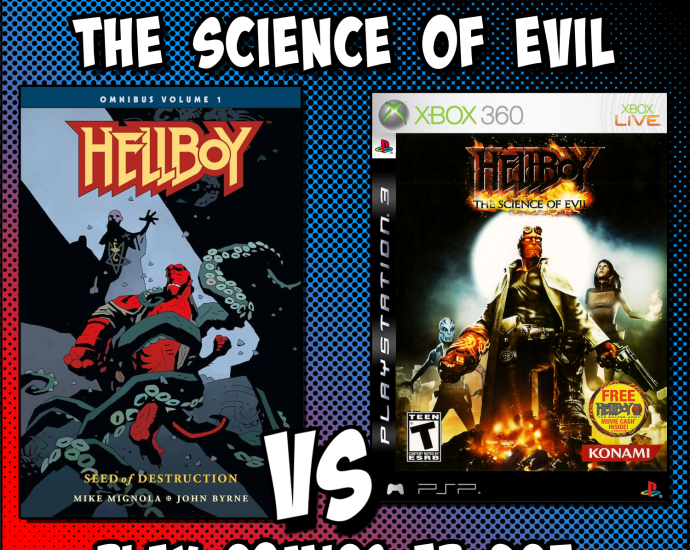
Every generation needs a reminder that games-based-on-movies-based-on-comics are their own strange little ecosystem, and Hellboy: The Science of Evil is a proud, slightly confused citizen of it. It doesn’t adapt either del Toro movie directly. Instead it just borrows the general vibe, invents its own plot, and trusts you to recognize a giant stone fist and a wisecracking demon without needing either film’s actual story. It’s the video game equivalent of a cover band that only plays originals.

And that giant stone fist deserves a moment, because it’s doing some real character-design heavy lifting. Hellboy is built around exactly one absurdly oversized body part, and that’s basically the whole design manual for a certain flavor of comic book tough guy: pick one appendage, blow it up past the point of reason, let the silhouette do the talking. Todd McFarlane ran the identical play with Spawn, except he went south instead of north, handing us a hero who could probably punt a sedan but might struggle to tie his own laces. One big fist, one big boot. Same weird design instinct, opposite ends of the body.

Which is a good excuse to bring in George Marston of Spawnography, the podcast where Pierce Lydon joins in to spend their time in the giant-boot corner of that exact design philosophy. George is flying solo this round to see how a giant fist holds up against a their usual task of studying a giant boot.

So pick your favorite oversized body part, brace for a beat-em-up that seems mildly allergic to its own source material, and let’s find out whether The Science of Evil earns a place next to del Toro’s films, or whether it belongs exactly where most tie-in games end up: forgotten. And don’t forget about the Nazi occultism.
Continue Reading
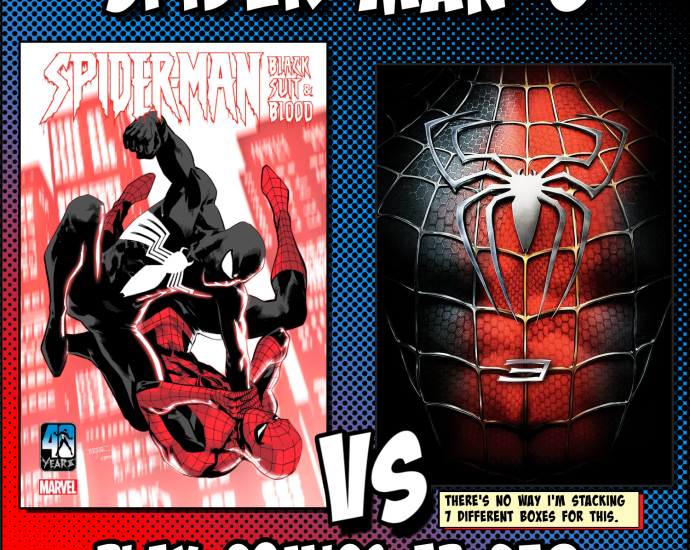
Let’s talk about Spider-Man 3, the movie where Sam Raimi looked at “menacing single antagonist” and said no thank you, I would like three, please, and also I would like Peter Parker to dance down the street like he’s auditioning for a jazz-hands cult. It’s a movie that tried to do everything, mostly succeeded at doing too much, and somehow still made enough money that Activision looked at it and thought: yes, this deserves not one video game, but two, spread across seven different consoles, so that literally nobody in 2007 could escape it. Ambitious! Chaotic! Extremely on brand for the source material!

See, there’s the fancy version, built by Treyarch for PS3, Xbox 360, and PC, where you get a whole open Manhattan to swing around in and the black suit shows up only when the story deems you emotionally ready for it, very mature, very earned. And then there’s the completely different budget cousin, built by Vicarious Visions for PS2, Wii, PSP, GBA, and DS, where you can slap the black suit on whenever you feel like being a jerk, the Wii Remote gets to pretend it’s a web-shooter, and the DS throws the D-pad in the trash entirely so you can beat up Sandman by poking a touchscreen like it owes you money. Same cover art. Same villains. Practically strangers.

Swinging in to help me sort out how many wildly different versions of one questionable movie a single franchise can generate is Harry Steele, co-host of Games on Film, the podcast where he and his brother Rory spend their days grading movies based on video games! Which means Harry has built an entire professional skillset around asking “did Hollywood mess this up,” and today, for one glorious episode, we get to point that same energy directly back at a video game and ask if it managed to mess up the movie right back. Poetic justice! Content symmetry! Whatever you want to call it, it’s happening!

So grab whichever suit you’re feeling today, pick a console, any console, apparently they all made their own decisions, and let’s find out if the Spider-Man 3 games handled three villains and seven platforms with any more finesse than the movie handled three villains and one dance number.Continue Reading

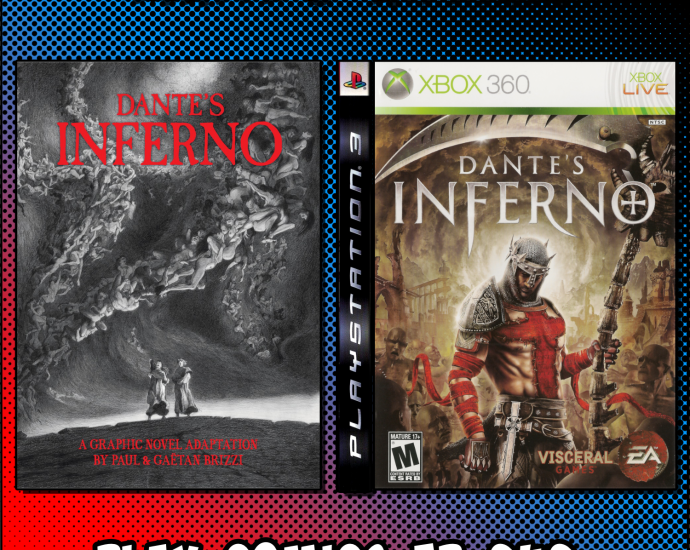
They say the road to Hell is paved with good intentions, but in this case, it’s paved with quick‑time events and awkward platforming. Step back into 2010, when grim determination, button mashing, and a suspicious amount of artistic license gave us Dante’s Inferno on the PS3 and Xbox 360, the game adaptation no one asked for but we secretly loved anyway.

Joining Chris this time is Adam Williamson. You know, that guy who’s somehow managed to pop up in both past and future episodes of Play Comics. It’s like he’s got his own metaphysical time loop going, except with fewer torturous souls and more witty banter.

So grab your favorite medieval poetry anthology (or just pretend you’ve read it. No judgment), crank up the over‑the‑top orchestral soundtrack, and prepare to descend through nine circles of beautifully rendered weirdness. Let’s find out how a centuries‑old Italian masterpiece got a glow‑up full of demons, guilt, and surprisingly good level design.Continue Reading

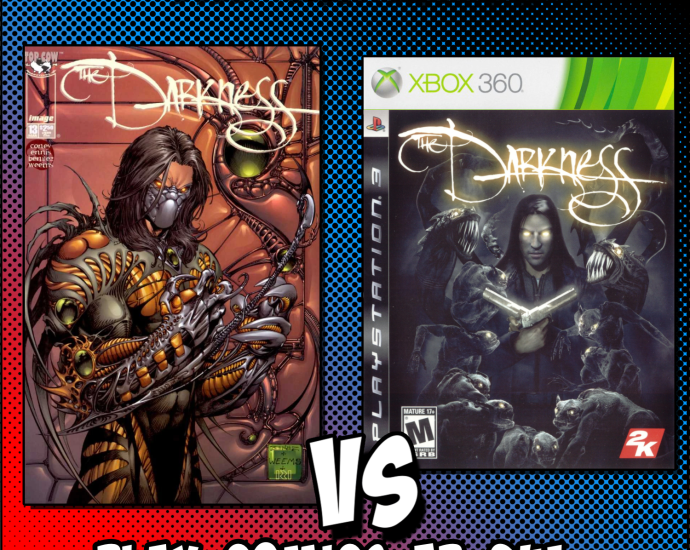
Look,  We’ve seen a lot of comic-based video games in my time, but when a mafia hitman gets murder powers from an eldritch shadow monster so he can take vengeance on, well, everybody, you know we’ve entered elite storytelling territory. The Darkness isn’t here to make you feel good about humanity. It’s here to make you ask if you’d trade your soul for a pair of talking demon heads who love street lamps way too much.

This week, we’re diving into The Darkness on PS3 and Xbox 360, that moody, gritty, and surprisingly heartfelt adaptation of the classic Top Cow comic series. And joining us for the chaos? None other than Sarah of Mars. Yes, that Mars. Because let’s be real: if you’re dealing with an ancient, malevolent cosmic force, you might as well bring in someone from a planet that already knows about hostile takeovers of a planetary variety.

So get comfy (preferably not in the subway tunnels of New York with a swarm of writhing demons), because we’re unpacking love, loss, corruption, and whatever dark surprises the game decided to throw at us just for kicks. Oh, and if your shadow starts talking back… maybe turn off the console.Continue Reading

This week on play comics we ask ourselves what happens if you you can’t decide what you want to make a game about. Should you just give up? Should you really dig into your soul and decide what you’re super passionate about? Should you look and see if there’s any other related media coming out that you can tie this game into? Or should you act like you’re at the end of five different boxes of sugary cereal and justice dump the mall into a single bowl and see what happens?

There’s certainly one thing that I made my mind up about this one, and that’s how Perry Constantine from Superhero Cinephiles and Japan on Film needed to come by and help me make sure that I kept everything straight here. And it’s a good thing too because with more playable character than I want to count spread out across 7 consoles upon release and a few more as back catalogs were taken advantage of it would have been really easy to miss something here.

So was there an actual story for this game? Or was it just a giant excuse to squeeze in as many tidbits as they could so the other kids would think they’re cool? You’ll have to listen to find out!Continue Reading