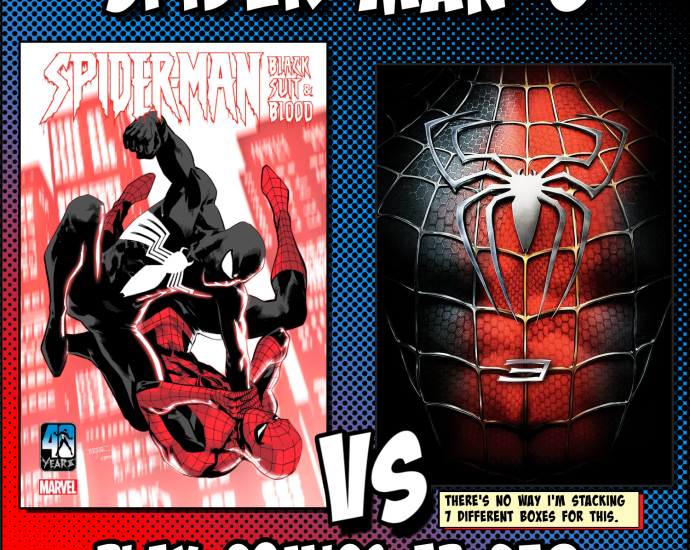


Let’s talk about Spider-Man 3, the movie where Sam Raimi looked at “menacing single antagonist” and said no thank you, I would like three, please, and also I would like Peter Parker to dance down the street like he’s auditioning for a jazz-hands cult. It’s a movie that tried to do everything, mostly succeeded at doing too much, and somehow still made enough money that Activision looked at it and thought: yes, this deserves not one video game, but two, spread across seven different consoles, so that literally nobody in 2007 could escape it. Ambitious! Chaotic! Extremely on brand for the source material!

See, there’s the fancy version, built by Treyarch for PS3, Xbox 360, and PC, where you get a whole open Manhattan to swing around in and the black suit shows up only when the story deems you emotionally ready for it, very mature, very earned. And then there’s the completely different budget cousin, built by Vicarious Visions for PS2, Wii, PSP, GBA, and DS, where you can slap the black suit on whenever you feel like being a jerk, the Wii Remote gets to pretend it’s a web-shooter, and the DS throws the D-pad in the trash entirely so you can beat up Sandman by poking a touchscreen like it owes you money. Same cover art. Same villains. Practically strangers.

Swinging in to help me sort out how many wildly different versions of one questionable movie a single franchise can generate is Harry Steele, co-host of Games on Film, the podcast where he and his brother Rory spend their days grading movies based on video games! Which means Harry has built an entire professional skillset around asking “did Hollywood mess this up,” and today, for one glorious episode, we get to point that same energy directly back at a video game and ask if it managed to mess up the movie right back. Poetic justice! Content symmetry! Whatever you want to call it, it’s happening!

So grab whichever suit you’re feeling today, pick a console, any console, apparently they all made their own decisions, and let’s find out if the Spider-Man 3 games handled three villains and seven platforms with any more finesse than the movie handled three villains and one dance number.Continue Reading

This week on play comics we ask ourselves what happens if you you can’t decide what you want to make a game about. Should you just give up? Should you really dig into your soul and decide what you’re super passionate about? Should you look and see if there’s any other related media coming out that you can tie this game into? Or should you act like you’re at the end of five different boxes of sugary cereal and justice dump the mall into a single bowl and see what happens?

There’s certainly one thing that I made my mind up about this one, and that’s how Perry Constantine from Superhero Cinephiles and Japan on Film needed to come by and help me make sure that I kept everything straight here. And it’s a good thing too because with more playable character than I want to count spread out across 7 consoles upon release and a few more as back catalogs were taken advantage of it would have been really easy to miss something here.

So was there an actual story for this game? Or was it just a giant excuse to squeeze in as many tidbits as they could so the other kids would think they’re cool? You’ll have to listen to find out!Continue Reading

Lock your squad into formation, charge your bolters, and prepare your genetically-enhanced blue skin for a parade of panzer-busting action because this week on Play Comics we’re putting boots to dirt in the grim, industrial wastelands of Rogue Trooper, the 2005 third-person shooter that took Gerry Finley-Day and Dave Gibbons’s iconic tale of a genetically engineered super-soldier and transformed it into a cover-based combat experience that somehow managed to capture the grit, the fury, and the desperate isolation of being a lone warrior against overwhelming odds. Originally deployed across PS2, Xbox, and Wii, Rogue’s had more platform changes than a soldier has armor repairs, eventually landing a remaster invasion on PS4, Xbox One, and Nintendo Switch, proving that some grimdark British sci-fi concepts just refuse to stay buried in the trenches.

Speaking of refusing to stay down, we’re genuinely thrilled to have Steve Morris from Shelfdust joining us for this deep dive. When he’s not busy operating as the marketing manager for 2000 AD itself, essentially being the guy who decides which corner of Judge Dredd’s dystopia gets the spotlight treatment, he’s the critical voice behind one of comics fandom’s most thoughtful, hilarious, and incisive podcast ecosystems. Steve brings both the insider knowledge of how 2000 AD operates AND the fan’s perspective that makes him the perfect guide through this particular adaptation’s journey from glossy magazine pages to console warfare.

Together, we’ll investigate whether this hyper-violent squad-based adventure managed to capture what makes Rogue Trooper such an enduring character, a soldier stripped of everything but his wits, his weapons, and three AI companions implanted directly into his equipment. Does the game understand the existential dread of being created solely as a weapon? Can it convey the isolation that defines the character while also providing the kind of multiplayer mayhem that defines the era? And perhaps most importantly: does this game explain why blue skin became the ultimate badge of being expendable in the far future?

Grab your tactical visor, synchronize your biometric links, and prepare for an episode that’s more explosive than a Rogue Trooper ambush and considerably more thoughtful than you’d expect from a game about murdering aliens on a lifeless planet.Continue Reading